
Economic and Health Care Impacts of Obesity Drugs
- Ayushi Dutta

- Dec 7, 2024
- 4 min read
Updated: Jan 25, 2025
I vividly remember 8th grade health class, sitting on the back of my seat taking notes on a presentation. We were learning about drugs, and the damage that they cause, something most health classes teach, yet a bunch of people still manage to ignore. One presentation stood out to me; specifically directed at the usage of diet pills, not to be confused with obesity drugs; of course.
Diet Pills vs. Obesity Drugs
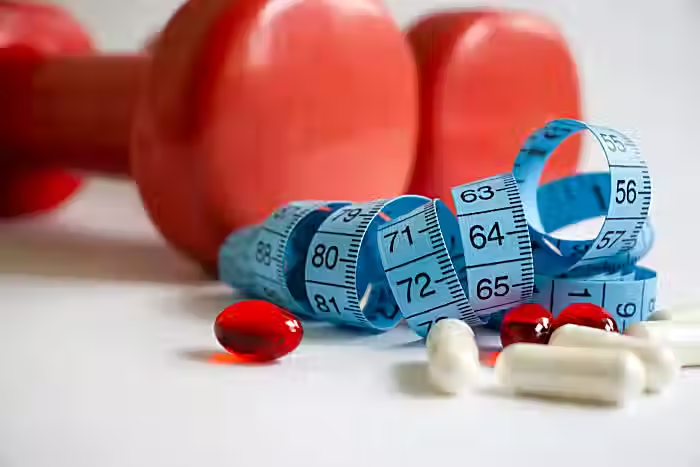
At first, I thought these two were the same, but turns out, they have some unique differences. Diet pills are over-the-counter medicine (OTC), something you may remember from your health class. This means a regular person, who isn’t necessarily overweight, can buy them. Diet pills are administered through tablets or capsules that contain chemicals that aim to control one’s body’s weight, usually by suppressing their appetite (Dictionary.com, n.d.). Their purpose is simply to reduce one’s appetite, and are not typically backed up by scientific evidence. On the other hand, obesity drugs are prescribed medicine for those who qualify as obese; people who have a body mass index (BMI) over 30. Obesity drugs can be administered through both pills and injections and require close monitoring from doctors to achieve a person’s desired weight loss (Mayo Clinic Staff, 2022).
But if our health teachers have had us believe that drugs are so bad, then what makes obesity drugs okay to administer? Well, it might sound a little confusing, but, all medicines are drugs, but, not all drugs are medicines. Drugs are meant to have positive and negative side effects, something most medicines include. Obesity drugs are no stranger to this, they offer amazing results and some notable changes in lifestyles due to their appetite-suppressing powers, but they also come with their side effects. Mainly, gastrointestinal issues, like nausea or diarrhea There can also be neurological side effects, like headaches or dizziness, or cardiovascular side effects like increased blood pressure. The most serious, but rare side effects include thyroid tumors' pancreatitis, or possibly some seizures (Obesity Medicine Association, 2024).
So… How Expensive Are Obesity Drugs?
It's important to acknowledge that while there could still be side effects, the results that these medicines offer are incredible. It is said that around 9% of the United States will be taking these obesity medicines by 2035 (Morgan Stanley, 2024). This means that the economic value of obesity medicines will be increased, and it will require lots of spending. By 2028, the drug glucagon-like peptide (GLP-1) will be used by around 30 million Americans, increasing the U.S. GDP by 0.4%, loads of millions of dollars in a trillion-dollar economy (Goldman Sachs, 2024).
But, while this profit is beneficial to the United States, what can people expect? Well, obesity drugs have a price range of 200-2,000 dollars a month (Gibbs & Primack, 2024). Obesity drugs are taken in rounds of 3 to 6 months, totaling costs up to 1,200 to 12,000, which frequently find themselves in the latter side (Mayo Clinic Staff, 2024). This means that they can have quite a heavy impact on the amount of your spending, which isn’t insured
The odds seem to stack themselves up even more when we account for the fact that getting rid of obesity improves the odds of longevity. But how is this a bad thing? Well, as Morgan Stanley (2024) puts it, “In fact, if formerly obese people increase their life expectancy, it may increase spending since older adults spend as much as three times more on healthcare than their younger counterparts.” This means that people who are obese, who spend 3,000 more dollars on healthcare annually, plus the 12,000 dollars for treatment, plus the ten-plus years of longevity do add up a price. For a better perspective, let’s do the math.
The Mathematics of Healthcare
NHE Fact sheet informs us that the average American spends 9,154 dollars on healthcare. Now we add up to 3,000 dollars to this price, totaling around 12,154 dollars for a year. Let’s assume this patient is in their fifties and became obese when they were thirty. This means that the patient has had 20 years of obesity, spending around 243,080 dollars for those 20 years. Most of this is insured, though, so the cost does reduce itself. We are just looking at the raw numbers here. Now we need to equate it to the first 10 years of childhood, spending around 4, 217 per year, equating to 42,170 dollars for those childhood years. Then we add up 20 years of the average American’s healthcare spending, 183,080 dollars. This means that this person has spent 468,330 dollars in healthcare in their life so far.
I haven’t even gotten to the obesity drugs yet.
We add 12,000, so $480,330. Now according to the CDC, the average American has a lifespan of 77 years, and this person has the same amount of lifespan now that they have lost weight. This person still has 27 years of life remaining and will have increased spending at the age of 65. For the first fifteen years, they will spend 137, 310 dollars, and for the last 12 years, they will spend around 22, 356 dollars per year. This means that they will spend 268,272 dollars for the remaining 12 years of their life.
This means that an American, who receives help from obesity medication, and still manages to drastically improve their health will spend around 885,912 dollars in healthcare in their life.
Thankfully, a good portion of it will be insured, by either Medicare or Medicaid. It’s disheartening to see people having to spend this much money on healthcare, even when they receive help. This means that an obese American will be spending roughly the same or more amount of money for a shorter amount of life. Obesity is a struggle so many face, and it's saddening to see that it costs so much money to get help.


Comments